

The State of Hydropower Digitalization in 2026
See what digitalized hydropower operations look like in 2026: real results from plants worldwide, plus a 5-question self-assessment to find your stage.
Introduction
Every hydropower operator feels it: markets moving faster, water behaving less predictably, experienced colleagues retiring, concession requirements stacking up. Digitalization has been heralded as the industry's standing answer to all of this, and it has been promised for years. In 2026, many such systems are running in production, and the results of digitalization projects across three continents are in.
That is what this paper does. It shows what digitalized hydropower operations actually look like today: data centralized and trusted, dispatch driven by prices or rules rather than fixed schedules, constraints enforced by systems instead of memory, and investment decisions tested by simulation before capital is committed. Operators running this way report concrete results, from 29% and 34% revenue gains to full environmental compliance with lean teams.
It also lays out how to get there. Digitalization is not one project but a sequence of five questions, explored here in the same order we have seen operators meet them. A short self-assessment places you on that path, and each question links to a dedicated deep-dive in this library. The market context that makes all of this urgent, region by region, is where we begin.
Section 1: The market context
A market that asks more of you
If you own, operate, or trade the output of a hydropower asset, the system around you is changing quickly, and much of that change works in your favour if you can respond to it.
The International Energy Agency describes the current period as The Age of Electricity. Global power demand is forecast to grow by more than 3.5% per year through 2030, at least two and a half times faster than overall energy demand. The growth is driven by industrial electrification, electric vehicles, air conditioning, and the expansion of data centres and AI infrastructure (IEA, 2026a). Much of the new demand will be met by renewables and nuclear, whose combined share of global generation is expected to reach 50% by 2030. Renewable generation is set to rise by roughly 1,050 TWh per year, with more than 600 TWh of that annual growth coming from solar PV alone (IEA, 2026b).
For an operator, the practical implication is clear: the power system is adding large amounts of generation that cannot be dispatched. Each gigawatt of solar added to your market deepens the midday price trough, steepens the evening ramp, and widens the spread between scarcity and surplus. Prices increasingly follow the weather, hour by hour within the day and season by season across the year.
The power system is adding large amounts of generation that cannot be dispatched. Each gigawatt of solar deepens the midday price trough, steepens the evening ramp, and widens the spread between scarcity and surplus.
Flexibility has become the product
In this system, the scarce commodity is no longer energy itself. It is the ability to deliver energy when weather-dependent sources cannot.
That is what dispatchable hydropower provides. Hydropower's relatively small share of the future generation mix (IEA, 2026b) works to its advantage here: flexible hydropower fills the gaps that wind and solar leave, and there is less of it than the system needs. For asset owners and trading teams, this combination of scarcity and volatility creates a favourable trading position, provided operations can actually capture it. A plant that needs hours to re-plan dispatch cannot monetise a price spike that lasts fifteen minutes.
Industry data reflects how the market is responding. The International Hydropower Association's 2026 World Hydropower Outlook reports 28 GW of new hydropower capacity commissioned in 2025, including a record 11.6 GW of pumped storage. Global pumped storage capacity passed 200 GW for the first time, and the IHA describes 2025 as the year the "water battery" came of age (IHA, 2026). The analogy is useful: pumped storage still outperforms electrochemical batteries on duration and scale by a wide margin, which is one reason the IHA also records growing governmental recognition of hydropower as strategic infrastructure for energy security and grid resilience (IHA, 2026). The report also notes a global development pipeline of 1,127 GW, meaning more flexible capacity, and more competition for the same balancing revenues, is on the way.

The same forces make operations harder
There is a symmetry worth noting: the trends that raise your asset's value also make it more difficult to run.
The climate patterns driving solar volatility also affect your water. The IPCC's Sixth Assessment projects continued disruption of the water cycle: more variable precipitation, more frequent hydrological extremes, and altered inflow patterns, with hydropower potential in Mediterranean Europe projected to fall by up to 40% under high-warming scenarios (IPCC, 2022). Water is becoming a scarcer, more contested, and more heavily regulated resource. In practice, this means inflow forecasts built on historical statistics are losing accuracy while environmental constraints and reporting obligations increase.
At the same time, many geographies face a second shortage: people. Experienced operational staff are retiring faster than they can be replaced, and the skills the current market rewards, such as data engineering and real-time optimization, are in demand across every industry.
This is the operating reality in 2026: aging assets, less predictable inflows, growing regulatory requirements, a shrinking workforce, and a market that prices responsiveness in fifteen-minute intervals. Staying dynamic under these conditions is difficult with manual processes and spreadsheets alone.
Digitalization as the operator's response
The sources cited in this chapter agree on one point: hydropower is valuable, and its place in the energy mix is secure. What is not guaranteed is any individual plant's ability to capture that value. The gap between what the system now requires, meaning real-time response, forecast-driven planning, auditable compliance, and market-speed trading, and what analog operations can deliver is the central operational challenge of this decade.
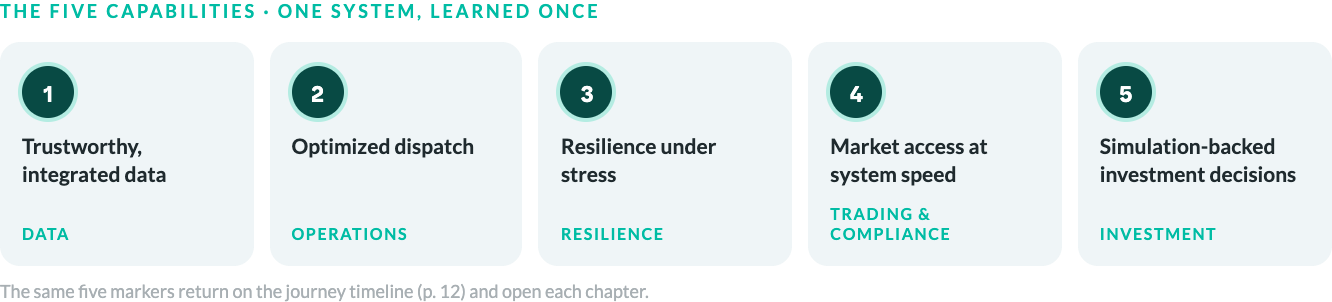
Closing that gap is what digitalization means in practice: trustworthy, integrated data; optimized dispatch that respects every constraint; resilience against hydrological shocks; market access at the system's speed; and investment decisions grounded in simulation rather than assumption.
This whitepaper walks through that journey stage by stage. At each stage, we point you to the dedicated deep-dive in our library that answers your next question.
Hydropower in market context, by region

Negative prices hit records in 2025 and the trend accelerated into 2026. The share of negatively priced hours reached 6% in 2025 in France, Germany, the Netherlands and Spain, up from around 3–5% in 2024 (IEA, 2026a). Germany alone logged 573 negative-price hours in 2025, a 25% year-on-year increase (Bloomberg, 2026), and EU-27 day-ahead markets recorded 1,223 negative-price hours in Q1 2026, more than double Q1 2025 (Ricardo, 2026). Depth varies as much as frequency: on 1 May 2026, under comparable holiday conditions, Spain's minimum price stayed near zero while Germany fell to around −250 €/MWh and France approached −500 €/MWh (Haya Energy, 2026). Flexibility and market design, not just solar share, determine the outcome.

South America's power markets are shaped by hydrology to a degree found nowhere else. Hydropower supplies roughly half of the region's electricity, with Paraguay near 100%, Colombia around 70% and Brazil around 55% (Rio Times, 2026; Argus, 2026). In markets like these, hydro is not one participant among many: reservoir levels and inflow expectations set the spot price for the entire system. When hydro is prepared, prices stay low; when it is not, thermal generation fills the gap and prices spike, as Colombia experienced in 2015-16 and again in 2024, when reservoirs fell toward critical levels and power exports to Ecuador were halted (i4sea, 2026; Environment+Energy Leader, 2026).
The variable that drives all of this, the El Niño-Southern Oscillation, is becoming both more intense and harder to plan around. NOAA declared El Niño conditions in June 2026 and gives a 69% probability that the October-December season becomes the strongest event since records began in 1950 (Rio Times, 2026). The impacts cut both ways at once: drought risk in the Amazon basin and the Andes, and flood risk in southern Brazil, where basin rainfall reached 256% of the long-term average in July 2026 and operators began spillway tests and emergency protocols months ahead of schedule (Reuters, 2026). The IEA notes that ENSO variability is itself a main source of inconsistency in precipitation and streamflow projections for the region, which means historical statistics are an increasingly weak basis for planning (IEA, n.d.).
For operators, the operational and the commercial problem are the same problem: the quality of your inflow forecasting and reservoir strategy determines not only your own dispatch, but your exposure to a market whose prices your preparedness helps set.
Region 3: North America

North America's pressure point is different: it is people and permits.
Operating a hydropower plant was traditionally a craft learned over years, often decades, alongside experienced colleagues. That transfer model is breaking down as hydropower must stay competitive and profitable in fast moving markets. As the veteran generation retires, plants increasingly need new operators to become effective within months, sometimes weeks, without the institutional knowledge that used to fill the gaps. Faced with this transition, many operators turn to systems to hold the knowledge that once lived in people.
At the same time, the regulatory environment is tightening. New and renewed concessions carry increasingly strict environmental conditions on water use, ramping rates, minimum flows and reservoir levels. In some cases the remaining flexibility window is so narrow that a single plant can no longer operate profitably within peak price hours, because its permitted water use does not align with when the market needs power.
The response emerging across the region is optimization at cascade level rather than plant level. By coordinating dispatch across a river system, operators redirect water toward the assets with the most flexible constraints while protecting concessional requirements at every plant in the chain. This is precisely the kind of multi-constraint, multi-asset problem that exceeds what manual planning can handle, and where digital cascade optimization earns its place.
Section 2: The Digitalization Journey
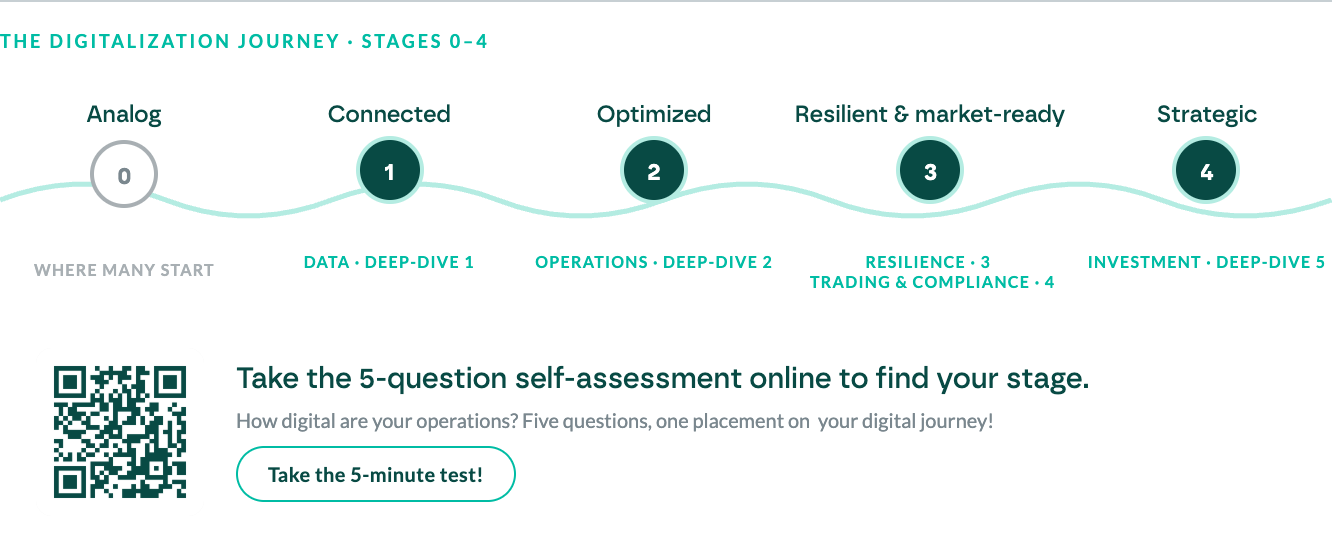
Latest developments in the industry reaffirm hydropower's place in the energy system is secure, but also underline that the demands placed on it are only going to intensify. This whitepaper explores how any individual plant can meet those demands with the help of digital tools.
This is the point where digitalization stops being a buzzword and becomes a practical answer. It works as a sequence of capabilities, each one mapped to a pressure already described:
- Trustworthy, integrated data that replaces manual handoffs and siloed systems.
- Optimized dispatch that captures the value flexible generation now commands.
- Resilience that holds constraints and continuity together when weather or markets move sharply.
- Market access at the speed the system now trades, in whatever form that market takes.
- Investment decisions built on simulation rather than assumption.
01 · Data: "Can I trust what my systems are telling me?"
For most plants, digitalization starts here, because it has to. Before a plant can optimize, forecast, or trade smarter, it needs a single, trustworthy view of what is actually happening on site.
That view rarely exists by default. Many operators run on a patchwork: SCADA readings in one system, maintenance logs in another, trading data manually re-typed into a spreadsheet before it reaches the market. Reporting depends on someone exporting a file and emailing it. Each handoff is a place where delay or human error can creep in, and in markets that now settle in 15-minute increments, that delay has a price attached to it. The alternative, a centralized hub with a clear overview of automations, that fosters real-time collaboration while helping operators prioritize and act quickly, seems an uncertain future possibility at best, and a dangerous sacrifice of safety at worst.
If your operations can already tick every box below, you have this first step down and can move on.
- Your historical, static, and technical data is digitalized and centralized. Does your team know where to find your production actuals from 5, 10, or 20 years ago? The efficiency curves of your turbines? Your gate throughput limits? All of this data feeds decisions you make every day, and it should be available in one place, at any time, by anyone who needs it, not reconstructed from archives when a question comes up.
- Your data has a memory. Automatic version history and backups mean you can report, troubleshoot, and backtrack without depending on whoever saved the last file. Regulators and auditors ask for records; a digitalized operation produces them as a byproduct.
- Your catchment area is mapped and aligned with the weather data you receive. Inflow forecasts are only as good as the weather data behind them. Have you tested what different weather extraction points do to your forecast accuracy, and identified which ones bring your predictions closest to what actually arrives at your intake?
- Your teams plan and bid in one shared tool, in realtime. Coordination by exported spreadsheet and email does not count. When production planning, maintenance planning, constraint management, trading, and ancillary service management happen in a single hub, each team works from the same live picture instead of yesterday's attachment.
- Your data compounds instead of fragmenting. This is the payoff of the previous point: when all operational tasks feed one system, the data they generate becomes usable for short, medium, and long-term decisions, from tomorrow's dispatch to next season's maintenance window to a multi-year investment case. Separate tools produce separate histories; a single hub produces one that integrates more variables and gets more valuable over time.
- Your telemetry arrives complete and on time. Sensor gaps, transmission outages, and manual meter readings all leave holes in the record that every downstream forecast and plan inherits. Backup pathways and automated collection close those holes before they become planning errors.
- Your connections are secure by design. Suppliers vetted against recognized standards such as ISO 27001 and SOC 2, and API-based connections rather than direct system linking, so that opening your data flows does not mean opening your plant.
The temptation is to skip ahead to the impressive part: AI-driven forecasts, automated dispatch, optimization at the push of a button. But none of it works without the foundations above. If items on that list are missing and you implement anyway, two things happen. Implementation drags beyond what you planned, and the tools start giving you advice that makes no sense, because a digital solution can only reason from the knowledge base it can access. A calculator is only as good as the equation put in front of it. So before concluding that digitalization is not yet advanced enough for the intricacies of hydropower, check whether the system can actually see correct, complete data streams. Getting that right is genuinely difficult in hydropower, which is exactly why it is the foundation and not a detail.
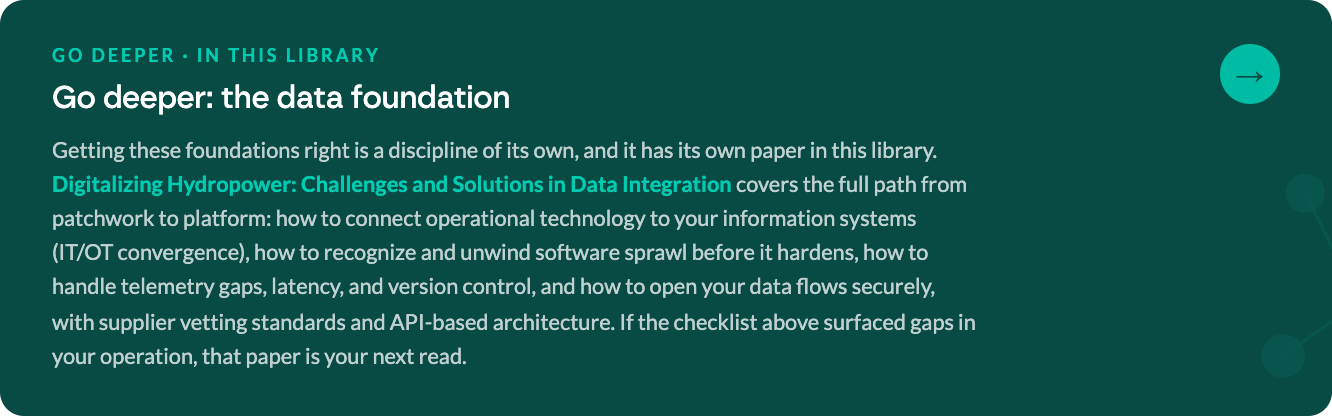
If you ticked every box, the next question is whether your operations are extracting full value from the assets you already have.
"The implementation of HYDROGRID Insight was an important step in our digital transformation journey. Thanks to it, we have replaced legacy tools that require manual input with reliable, consistent, and secure data flows.
John Downes · CIO, SSE Renewables
02 · Operations: "Am I getting what I should from the assets I already have?"
With trustworthy data in place, the next question is what to do with it. For most plants, the answer starts with dispatch, and here the case is best made by results rather than argument.
+6.7% generation. In a complex site with limited water resources, algorithmic water-value calculation lifted power generation by 6.7% compared to manual planning of expected production. Same water, same turbines, better sequencing.
Up to +10% generation. Across client plants, combining hydrological modeling, inflow tracking, meteorological forecasting, and cascade coordination has increased power generation by up to 10% while reducing grid costs.
Small teams, full coverage, every constraint respected. A Norwegian operator with a 1913-built cascade of connected reservoirs, gates, and turbines, automated its coordination end to end. The result: spill and imbalance costs avoided, price-driven dispatch capturing volatility opportunities, all environmental restrictions followed automatically, and a cascade optimized with fewer personnel and less manual effort.
Its managing director puts the reason plainly: prices now swing by thousands of percent several times a day, and a human planning cycle cannot keep up. Automation can.
"For nearly a century the power market had moved slowly and predictably. Today it is undergoing a revolution, with prices swinging by thousands of percents several times a day. The reality is simple, we can't keep up and automation can."
Rune Hetland · Managing Director, Dalane Kraft
The gains scale down as well as up. Haneseth runs its Kvina power station fully automatically, with dispatch and forecasting handled end to end. Småkraft coordinates more than 200 small plants with a deliberately lean organization. Savon Voima reports improved financial performance alongside full environmental compliance and better water-level control. The pattern across all of them: fewer manual hours, every constraint respected, more value per cubic meter.
The tools behind these numbers have names. Price Driven Dispatch (PDD) continuously adjusts production against real-time and forecast prices within your operational and environmental limits. Cascade optimization treats a multi-plant, multi-reservoir system as one coordinated asset, directing water toward the most flexible turbines ahead of a price or weather event. For plants with sufficient storage, Limit Order Bidding (LOB) bids production conditionally against price ranges rather than committing fixed volumes in advance.
None of this requires new hardware. It requires the data foundation we've explored above, and software that can reason over it. If your dispatch is still schedule-driven, start there. If your operations already run price-aware, the next question is whether they hold up when conditions turn violent.
Go deeper: efficiency in operations
HYDROGRID Efficiency in Hydropower Operations works through each of these results in full: how PDD and LOB function mechanically, when cascade optimization pays off and for which topologies, how inflow forecasting feeds the planning stack, and the complete case studies behind the numbers above.
03 · Resilience: "Can my operations withstand what the weather and the grid throw at them?"
It is 2 a.m. on a Saturday. A storm formation has stalled over your catchment, and inflow is arriving at three times the forecast rate. The reservoir will reach its regulatory maximum in roughly six hours. Downstream, flow limits set by the local authority cap how fast you can release. On the market side, prices are spiking, because the same storm is curtailing wind across the region, and solar PV is obviously not a factor here.
The same night, two ways
In a manual operation
In a manual operation, this night looks like phone calls. Someone drives to site. The duty engineer pulls up last season's spreadsheet and tries to reconstruct how much room the upper reservoir really has, whether the planned Monday maintenance on turbine two changes anything, and what the environmental flow requirement allows at this hour. Hour after hour pass, limiting the available dispatch options and pressuring the staff on call to take a decision, fast. Every move is made under time pressure with partial information, and documented, if at all, after the fact.
The Brisbane 2011 flood litigation, which ended in a $440 million settlement over allegations that the operator failed to make room for forecast rainfall in time, shows where the worst version of this night leads.
In a digitalized operation
In a digitalized operation, the same night looks different. The inflow spike was flagged early, because machine-learning forecast models trained on this specific catchment detected the deviation as it developed, not after the gauge confirmed it.
The platform has already recalculated reservoir trajectories against every constraint, and proposed a revised dispatch. Three things happen at once:
- Every constraint held. Upper and lower bounds, downstream flow limits, environmental minimums, in their order of importance to you.
- The emergency turns into revenue. Water releases through the highest-value turbines during the price spike.
- The inflow gets its headroom. That same release creates the storage the inflow requires.
The on-call engineer reviews, corrects any decision that they flag as dangerous and approves from home. Every parameter, override, and decision is logged automatically, which means the regulator's questions on Monday have answers on file. The event left its dent, but it's nothing you can't mitigate in the near future.
The difference between these two nights is not the weather, and it is not the skill of the people involved. It is whether the plant's knowledge lives in systems or in individuals who have to be woken up. That distinction matters more every year: extreme weather events are increasing in frequency and severity, historical patterns are becoming less reliable as a planning basis, and the experienced staff who used to carry plants through nights like this are retiring faster than they can be replaced. Resilience, in practice, is the ability to have a routine night during an extreme event.
If the 2 a.m. scenario above felt uncomfortably familiar, that paper is your next read. If your operations are already resilient, continue here: the next question is how all of this converts into market value.
"HYDROGRID Insight transformed our inflow forecasting process. By combining smart automation with local expertise, we can now better predict challenging weather conditions. The system continuously improves itself while still allowing manual input, making dispatch planning simpler, safer, and more reliable."
Joachim Jonas · Head of Operations, RWE
04 · Trading & Compliance: "How do I capture value, whether or not I have a price signal to trade against?"
Everything so far has assumed a plant that can see, plan, and react quickly in daily operations. This section is about turning that operational readiness into revenue. It is also where this library forks, because the answer depends on a single question:
Do you sell your power at market prices, or at a fixed price set by contract or regulation?
Yes: the energy trader path
Liberalized markets, the trading clock keeps accelerating. Europe's coupled day-ahead and intraday markets now settle in 15-minute intervals across all bidding zones. The stressed grid translates to negative-price hours multiplying year over year. North America runs even faster in places: the major system operators settle real-time markets in 5-minute intervals, and prices are set locally, node by node, so two plants on the same river can face different prices at the same moment. Add the growing depth of negative prices during solar-heavy hours in markets like California and Texas, and the pattern is the same on both continents: revenue no longer comes from producing steadily, it comes from producing at the right quarter-hour, in the right place, and from knowing when not to produce at all.
In practice, this means the same tools you use to run the plant start earning money on the market. Take Price Driven Dispatch. Your reservoir holds water that is worth more at some hours than at others. PDD keeps comparing that value against live market prices and adjusts production accordingly, automatically and within your constraints. When a price spike hits at 14:15, the plant is already producing into it. Without this, you are selling into today's prices with a plan someone wrote yesterday afternoon.
Limit Order Bidding lets you bid conditionally: when prices fall below your threshold, water stays in the reservoir instead of being committed blind, and that stored water becomes tomorrow's higher-priced generation. Market Order Bidding closes the last gap between optimization and execution by converting the output into a nominated bid, ready for the exchange or sent there directly, which removes both the manual processing step and the transcription errors that come with it. Together, these tools attack the most expensive recurring error in hydro trading, misestimating available water, which flows straight into imbalance costs on either continent.
The ceiling is higher still. A plant whose data flows reliably into one system can qualify for the markets that pay for readiness rather than energy: primary and secondary reserve in Europe, frequency regulation and ancillary services in North America. These products demand proof that you can deliver on command, which is precisely what integrated, auditable operations provide. For a flexible hydro asset, they can turn the same water into a second revenue stream.
No: the regulated path
In regulated and single-buyer markets, price-driven dispatch is unavailable by design. The question does not disappear; it changes shape. Operators here must optimize within fixed obligations, demonstrate compliance continuously, and make the strongest possible case for capacity, off-take, and refurbishment funding without a live price to argue from. The disciplines are the same ones this hub has been building since the first chapter of this paper, trustworthy data, constraint-aware planning, auditable operations, applied to a different objective function: maximum value from a fixed set of rules.
+34% revenue. A mid-sized European storage plant, 140 MW across four turbines, operates under regulatory constraints so tight that its water-value optimization window is only about 7%. Within that narrow band, switching from fixed schedules to price-driven dispatch, producing only when prices cleared a set threshold, increased revenue by 34% over non-optimized planning. The optimization window was small; the return on using it was not.
+29% revenue across 16 plants. Dalane Kraft, a Norwegian operator whose oldest assets date to 1913, replaced manual scheduling across its 16-plant portfolio with automated, market-integrated dispatch.
"We saw 34% higher revenue compared to manual plant operation, all without adding any extra personnel."
Marc Jermann · COO, aventron AG
Both paths share one requirement: compliance is no longer a periodic reporting exercise. Whether the counterparty is an exchange, a balancing authority, or a regulator, the operations that win are the ones whose records are produced automatically as a byproduct of daily work.
05 · Investment: "Is the next capital decision the right one?"
The final question sits above daily operations: whether to build, retrofit, acquire, or reconfigure the asset itself. The consequences of these decisions run for decades, and the way they are usually prepared has not kept pace with what is now possible.
Deciding the traditional way means commissioning studies that take months and rest on averages. Annual generation is represented by a single number. The standard financial metrics, Net Present Value (NPV, the project's lifetime profit expressed in today's money), Levelized Cost of Electricity (LCOE, the break-even price per unit of electricity generated), and Financial Internal Rate of Return (FIRR, the effective annual return on the capital invested) are calculated from simplified assumptions about how the plant will run, usually the same way in every circumstance. Hydrological models are built by hand in spreadsheets. The result is a business case with three structural weaknesses: it ages quickly, it cannot say how the project performs if the weather or the market deviates from the assumed average, and it leaves investors and lenders, already cautious about hydro's construction risk and decade-long horizons, to price that uncertainty into their terms.
Adding simulation to the process does not replace the professional work a capital project requires. Feasibility studies, engineering assessments, and financial advisors all remain part of a serious project. What simulation changes is the quality of the ground they stand on. The digital twin that runs daily dispatch, the plant's topology, constraints, efficiency curves, and inflow behavior, can test a new turbine, a pumped-storage retrofit, a changed dispatch strategy, or an acquisition target's potential, in hourly resolution, across multiple weather and market scenarios, before any capital is committed. The standard metrics stay in place but gain a stronger footing: an NPV built from simulated hourly operations rather than one annual assumption, an LCOE that reflects smart, price-driven operation instead of assuming the plant runs identically in all conditions, an FIRR tested against a range of hydrological futures rather than one. The result is not a different decision process. It is the same process, with a range of documented, reproducible ROI outcomes on the table instead of a single estimate, which is the kind of transparency cautious lenders respond to.
One example of the method applied: Hyvity used investment decision simulation to design a closed-loop pumped storage project in a desert region, testing reservoir sizes and head configurations against solar-driven price spreads, cycle efficiency, and evaporation losses, and arrived at a layout that balanced profitability with operational resilience before construction. An investment decision made without simulation is, increasingly, a decision made with incomplete information at exactly the moment complete information has become available.
"By using HYDROGRID Insight to simulate our investment decisions, we are able to set up a 'virtual twin' of any plant in our portfolio and fully simulate a potential investment decision within just a few days. This has allowed us to make strategically much more informed investment decisions with a much quicker project lifecycle."
Øystein Flåt · Head of Asset Management, CADRE
Conclusion: The digitalized operation is no longer a concept
This is what the state of hydropower digitalization comes down to in 2026. The digitalized operation is no longer a concept: it runs today, at plants from 1 MW to full portfolios, with documented results in revenue, compliance, and workload. And the way in is not a leap but a sequence, five questions answered in order, starting from wherever your operation stands now.
The practical next step is small. Take this self-assessment test, find your stage, or find the one paper in this library that answers your current question. The plants quoted in these pages all started the same way: not by digitalizing everything in one massive overhaul, but by fixing the foundation in front of them.
How digital are your operations? Take the 5-question self-assessment to find your stage.
Get in touch with our hydro consultants to learn how!
